IV Calculator: How to Check Pal Potential and Max Stats
How to check IVs in Palworld — what the hidden 0-100 Potential rolls do to HP, Attack and Defense, how to read them with Ability Glasses or back them out of the stat screen with our Pal stat calculator, and the exact cost of maxing all three lines.

Two Pals of the same species at the same level can hit for wildly different numbers, and the reason is three hidden rolls the game calls Potential — what everyone else calls IVs. Here's what those rolls are worth in raw stats, how to read them with or without the glasses, and what it costs to take all three to 100.
 Palworld IVs at a Glance
Every Pal carries one Potential roll per combat stat, graded 0 to 100, fixed the moment it hatches or gets caught. A perfect 100 multiplies the level-scaled part of that stat by 1.3, so the gap between a junk roll and a perfect one widens as the Pal levels — it's small at level 10 and worth hundreds of points by level 50. Work Speed, element and partner skill are untouched by any of it.
| Question | Answer |
|---|---|
| Which stats have IVs? | HP, Attack and Defense — three separate rolls, one per stat |
| What's the scale? | 0 to 100 per line, rolled at hatch or capture |
| What is 100 worth? | ×1.3 on the level-scaled portion of that stat |
| How do you see it? | Ability Glasses — Ancient Technology Lv 34, 4 points |
| How do you raise it? | Life Fruit, Power Fruit and Stout Fruit, +10 each |
| Cost to max one line | 10 fruits from a zero roll — 250 Successful Bounty Tokens |
| Does breeding pass it down? | Yes — at least one of the three lines is copied from a parent |
| What doesn't touch it? | Levels, passives, star ranks, soul ranks and Trust all move stats, not the roll |
The two rows people get wrong are the last two. Potential is not something you grind up from zero on any Pal you like — fruits move it 10 at a time and nothing else does, so a Pal that hatched at 0 Attack needs ten Power Fruits to catch a Pal that hatched at 100. And a maxed  Statue of Power Pal with a 12 Attack roll still reads 12 in the glasses; the soul ladder stacks on top of the roll rather than fixing it.
How to Check IVs with Ability Glasses
The direct route is an accessory. Equip either pair of glasses and every Pal you look at — in the overworld, in the party menu, in the box — shows its three Potential values on the 0 to 100 scale. Both sit in the Ancient Technology tree, so you need Ancient Civilization Cores before either is craftable.
| Accessory | What it does | Materials | Weight |
|---|---|---|---|
| Ability Glasses | Shows HP, Attack and Defense Potential, 0-100 | 30 Refined Ingot, 20 Paldium Fragment, 10 Ancient Civilization Parts, 5 Ancient Civilization Core | 1.0 |
 Pal Tamer's Glasses Pal Tamer's Glasses | Same reading, and your attacks can't drop a target below 1 HP | 20 Refined Ingot, 30 Paldium Fragment, 10 Ancient Civilization Parts, 15 Ancient Bark | 2.0 |
If you're still filling the Paldeck, the Tamer's Glasses are the better craft by a mile — the damage floor means you can empty a rocket launcher into a legendary and still throw the sphere, and you get the Potential readout for free. Once the catching is done, swap to the plain Ability Glasses for half the weight. Neither needs a core-hungry endgame base to make: five cores is a couple of Feybreak crates, and the Ancient Civilization Core guide covers the fastest taps.
 How to Work Out IVs Without the Glasses
Before level 34 you can still get the number — it's just arithmetic on the stat screen. Open the Pal stats calculator, pick the species and drag the level slider to your Pal's level. It prints two columns: what that Pal would have at Potential 0 and at Potential 100. Your Pal's real stat sits somewhere between them, and where it falls between the two ends, as a percentage, is the roll.
Worked example with Astralym at level 50: the calculator gives an Attack floor of 850 and a ceiling of 1,075. A level-50 Astralym showing 962 attack sits almost exactly halfway between them, so its Attack Potential is around 50. Showing 1,070? That's a near-perfect roll. Showing 855? Sell it to the condenser.
Three things will throw the reading off, so strip them out first:
- Passive skills multiply the finished stat, so a Pal with Ferocious or Legend reads high on Attack for reasons that have nothing to do with its roll — check the passive list on the Pal before you trust the number
- Star ranks and soul ranks both add on top, so use a Pal you haven't fed to the
 Pal Essence Condenser or the Statue of Power yet
 - Trust climbs through ten ranks and scales stats as it goes, so read a fresh Pal rather than your long-serving mount — the Trust level page has the per-rank thresholds
Pocketpair has never published the stat-growth formula, so treat the two endpoint numbers as close estimates rather than to-the-point exact — good enough to tell a 20 roll from an 80 roll, not good enough to argue over one point. A newly hatched egg with no passives, no stars and no souls is the cleanest thing to read.
What a Perfect Roll Is Actually Worth
Here's the spread at level 50 for the Pals worth building. The left number in each pair is a 0 roll, the right is 100 — everything else about the Pal is identical. Astralym gains 1,500 HP and 225 attack from its rolls alone, which is more than most Pals' entire attack stat, because a 1.3× multiplier pays out biggest on the biggest base line.
| Pal | HP (IV 0 → 100) | Attack (IV 0 → 100) | Defense (IV 0 → 100) |
|---|---|---|---|
| Astralym | 5,750 → 7,250 | 850 → 1,075 | 800 → 1,025 |
 Panthalus Panthalus | 5,250 → 6,600 | 550 → 685 | 800 → 1,025 |
 Frostallion Noct Frostallion Noct | 4,250 → 5,300 | 625 → 782 | 556 → 708 |
 Necromus Necromus | 4,000 → 4,975 | 643 → 806 | 500 → 635 |
 Bellanoir Libero Bellanoir Libero | 3,750 → 4,650 | 662 → 831 | 425 → 537 |
 Shaolong Shaolong | 4,250 → 5,300 | 606 → 758 | 500 → 635 |
Two caveats on reading that table. The Attack column follows each Pal's ranged attack line, so melee specialists come out understated — Jormuntide Ignis and Blazamut Ryu both swing 150 melee against a 130 ranged line, and they only compare fairly against other melee bruisers. And the whole spread scales with level: on a 200 attack line the gap between a 0 roll and a 100 roll is 45 points at level 10, 225 at level 50 and 270 at level 60. Chasing perfect rolls on a Pal you'll never take past level 30 is wasted effort.
 How to Raise Potential: The Three Fruits
One consumable per stat line, +10 Potential each, no cap-out until the line hits 100. That makes the math clean: a Pal reading 40 Attack needs six Power Fruits, a zero roll needs ten, and taking all three lines from nothing to perfect is 30 fruits. All three sell at three separate counters, so you pay with whichever currency you're sitting on:
| Fruit | Raises | Per use | Bounty Shop | Arena Shop | Medal Shop |
|---|---|---|---|---|---|
 Life Fruit Life Fruit | HP Potential | +10 | 25 Bounty Tokens | 100 Battle Tickets | 200 Dog Coins |
| Power Fruit | Attack Potential | +10 | 25 Bounty Tokens | 100 Battle Tickets | 200 Dog Coins |
 Stout Fruit Stout Fruit | Defense Potential | +10 | 25 Bounty Tokens | 100 Battle Tickets | 200 Dog Coins |
The Bounty Shop is not close to a fair fight — the identical fruit runs 25 tokens there against 100 Battle Tickets or 200 Dog Coins. Maxing all three lines is 750 Successful Bounty Tokens at the bounty counter, 3,000 Battle Tickets at the Pal Arena, or 6,000 Dog Coins at the Medal Shop. Work the bounty board first and save the arena tickets for skill fruits.
 Crafting Fruits from Stat Lotuses
If you'd rather not spend currency, every fruit has a recipe built entirely out of stat lotuses, and lotuses grow wild — there are 866 stat lotus pins on the interactive map's lotus layer, plus more out of oil rig crates and relic recycling. Power Fruit is the cheapest of the three at nine lotuses instead of twelve, which is handy since Attack is usually the line you want capped first.
| Fruit | Materials | Lotuses needed |
|---|---|---|
| Life Fruit | 3 Life Lotus (S), 3 Life Lotus (L), 3 Speed Lotus (S), 3 Carrying Lotus (S) | 12 |
| Power Fruit | 3 Power Lotus (S), 3 Power Lotus (L), 3 Speed Lotus (L) | 9 |
| Stout Fruit | 3 Stamina Lotus (S), 3 Stamina Lotus (L), 3 Carrying Lotus (L) | 12 |
Each recipe carries a heavy work cost, so this is a job for your best Handiwork bench rather than something you knock out by hand. Thirty fruits by hand means 330 lotuses, which is why most people mix the two routes: buy the Attack line, farm the rest. Where each lotus tier drops is broken down in the IV fruit farming guide.
 Breeding for Better Rolls
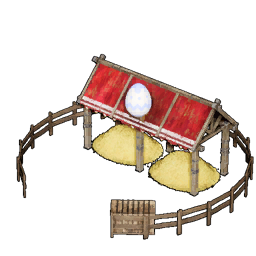
Fruits close a gap; breeding is how you start from a better number. At least one of a child's three Potential lines is copied from one of its parents, and you don't get to pick which line or which parent — the other two either follow a parent as well or get rolled fresh. That's why a line is worth running instead of hatching a few eggs and taking the best: every egg is a re-roll on two of three slots with a guaranteed floor on the third.
Pair the same species with itself and the child is that species too, which turns the Breeding Farm into a pure stat re-roller — nothing about the hatch is in question except its rolls and its passives. Keep whatever beats both parents, promote it into the pair, retire the loser, and the floor climbs every generation. Cakes bias the dice:
| Cake | What it does for a Potential line |
|---|---|
 Mushroom Cake Mushroom Cake | Talents grow more easily — the cake to run while you're hunting rolls |
 Extravagant Vegetable Cake Extravagant Vegetable Cake | Easier talent growth plus a raised mutation rate |
 Special Cake Special Cake | Better odds of inheriting multiple passives — pair it with the roll hunt so one hatch settles both |
Don't hold out for a perfect pair. You only need rolls inside fruit range: a line that lands at 60 is four Power Fruits from capped, so set the target at whatever your fruit supply can close and stop hatching there. The full inheritance and species rules live in the breeding mechanics guide, and the breeding calculator finds the cheapest parent pair for whatever species you settled on.
What Raises Stats but Not Potential
This is the trap that makes people think their calculator reading is broken. Half the systems in the game raise a Pal's displayed numbers without ever touching the 0-100 roll, so a heavily invested Pal reads far above the calculator's IV 100 column and a fresh one reads dead on it. Everything below stacks on top of Potential rather than into it:
| System | What it raises | Moves the 0-100 roll? |
|---|---|---|
| Levelling up | All three combat stats, on a curve | No |
| Passive skills | Percentage multipliers on Attack, Defense, HP | No |
| Pal Essence Condenser | Star rank — overall stats and partner skill scaling | No |
| Statue of Power | A 20-rank soul ladder, 52 souls end to end | No |
| Trust level | Stat scaling across ten ranks | No |
| Potential fruits | +10 on one line, up to 100 | Yes — the only thing that does |
Practical consequence: read Potential on a clean Pal, then invest. The order that wastes nothing is settle the species, roll the passives, read and top up the three lines with fruit, then climb the star and soul ladders on the body you've decided to keep — that sequence is laid out step by step in the min-max guide. Going the other way round means pouring 30 Giant Pal Souls into a Pal you later find out rolled 8 Attack.
Related Guides
Tools and pages that pair with this one:
- Palworld Pal Stats Calculator: HP, Attack and Defense by Level
- Compare any two Pals' base stats side by side
- All Pals by Max IV Stats: Highest HP, Attack, Defense
- How to Min-Max Pals: IVs, Passives, Souls, and Condensing
- How to Farm IV Fruits and Training Crystals Fast
- How Breeding Works: Combi Ranks, Unique Combos, and Inheritance
- How to Rank Up Pals: Condenser, Ripe Starfruit, and Handbooks
- All Pal Stats Explained: HP, Attack, Defense, and IVs
- Best Stats to Level Up: Priority Order and Stat Caps
- All Palworld guides